
The video production industry is undergoing a transformation that many compare to the transition from film to digital. Artificial intelligence (AI) is no longer an exotic novelty and is becoming a full‑fledged multidisciplinary assistant capable of handling a wide range of tasks: from generating backgrounds or special effects to transforming characters in films, such as de‑aging the actors in Martin Scorsese’s “The Irishman.”
But can AI cope with truly creative tasks? Is it capable of replacing the human creative spark – the director, the documentarian, the author? In this text, we will try to understand what changes AI is bringing into the field of video production, how deeply it is already embedded in the process, and whether it can ever displace humans. Helping us unpack this is documentary director Doug Werby.
From “Repair” to “Reanimation” of the Image
We have already grown used to the idea that AI is reshaping familiar processes and taking over routine work that used to consume up to 70% of production time. But we much more rarely think about what exactly these systems do and how they change the creative logic of working with the image.
AI in video production: from upscaling to puzzle‑making. AI’s entry into film production was purely technical and mainly associated with working on already shot material, to which algorithms gave a second life. In the past, the low resolution of old music videos and archive footage almost guaranteed that a clip would sink into oblivion; today, creators have tools that can literally “revive” frames.
Modern upscaling systems analyze an image not as a set of pixels, but as a set of recognizable patterns: faces, fabrics, textures, object edges. Based on this, the models reconstruct missing details, restore sharpness, and reduce the noise of old sensors. Solutions like Topaz Video AI use specialized models (Proteus, Iris, Nyx, etc.) that treat overall details, faces, noise, and motion differently, and can also stabilize shaky footage and interpolate frames for smooth 60 fps or deep slow motion. For catalog owners and creators this means that footage shot decades ago in 480p or 720p can be turned into a native‑feeling 4K and even 8K experience, while cleaning up scratches, dirt, noise, interlacing, and camera shake.
And this tool is already part of Doug’s toolkit.
– The shift from simple utility to creative integration is profound. We’ve moved past basic “repair” into a realm of “rejuvenation.” For example, I recently took a project I directed in 1995 - originally captured in a pixelated 640 x 480 resolution - and upscaled it to a native-feeling 4K. This isn’t just technical upscaling; it’s a creative restoration that allows legacy footage to live comfortably alongside modern cinematography. It grants the work a second life, meeting 2026 delivery standards without compromising the original creative vision. Example:
Generative Video and “Armchair Directing”
Meanwhile, modern AI systems have gone much further and are no longer purely technical tools. Today they cover almost every stage of video production: from ideation and pre‑production to post‑production and localization.
Generative models make it possible to go from a text description to a cinematic fragment without a film crew, soundstage, or physical locations. Models such as Sora, Veo, Runway Gen‑3 and Kling can create photorealistic scenes, complex background environments, and even short narrative episodes from text prompts. Studios are already starting to reorganize post‑production around generative models, because for some VFX scenes it is cheaper to generate them in the cloud than to build sets and maintain large teams. In this new configuration, the director’s role inevitably changes as well.
– AI has fundamentally restructured my professional workflow. It isn’t just one tool; it’s a multi-disciplinary assistant. I’m currently delegating a broad spectrum of technical and creative tasks to various models - ranging from surgical audio restoration and synthetic voice-overs to generative music composition. Beyond utility, it serves as a powerful conceptual partner, allowing me to storyboard with high-fidelity imagery and up-res assets to modern standards, effectively bridging the gap between a mental concept and a visual proof-of-concept, says Doug.
Today, the director’s role increasingly resembles that of a conductor leading a complex orchestra of tools, or a puzzle‑maker assembling a finished picture out of many fragments. This is exactly the image Doug uses:
– I’ve started referring to this evolution as “Arm-chair Directing.” When I’m helming a project driven by generative AI, the process becomes non-linear and incredibly fluid, much like the editing process itself. I might sit at my console and begin at scene seven because the visual assets for that moment are the most defined, then work backward to fill the narrative gaps.
The director’s role has shifted from managing physical logistics to becoming a “master of the puzzle,” conjuring and prompting scenes directly from the desktop. While the tech isn’t flawless yet, the leap in capability over the last few years has turned the director into a high-level orchestrator of “instant” iteration.
Pre‑Production 2026: From Moodboards to Living Pre‑Viz
If pre‑production once relied on static moodboards and rough storyboards, by 2026 the standard is dynamic pre‑visualization. The process of developing the creative concept has become faster and cheaper at almost every stage, and the line between “draft” and “final” decisions is getting increasingly blurred.
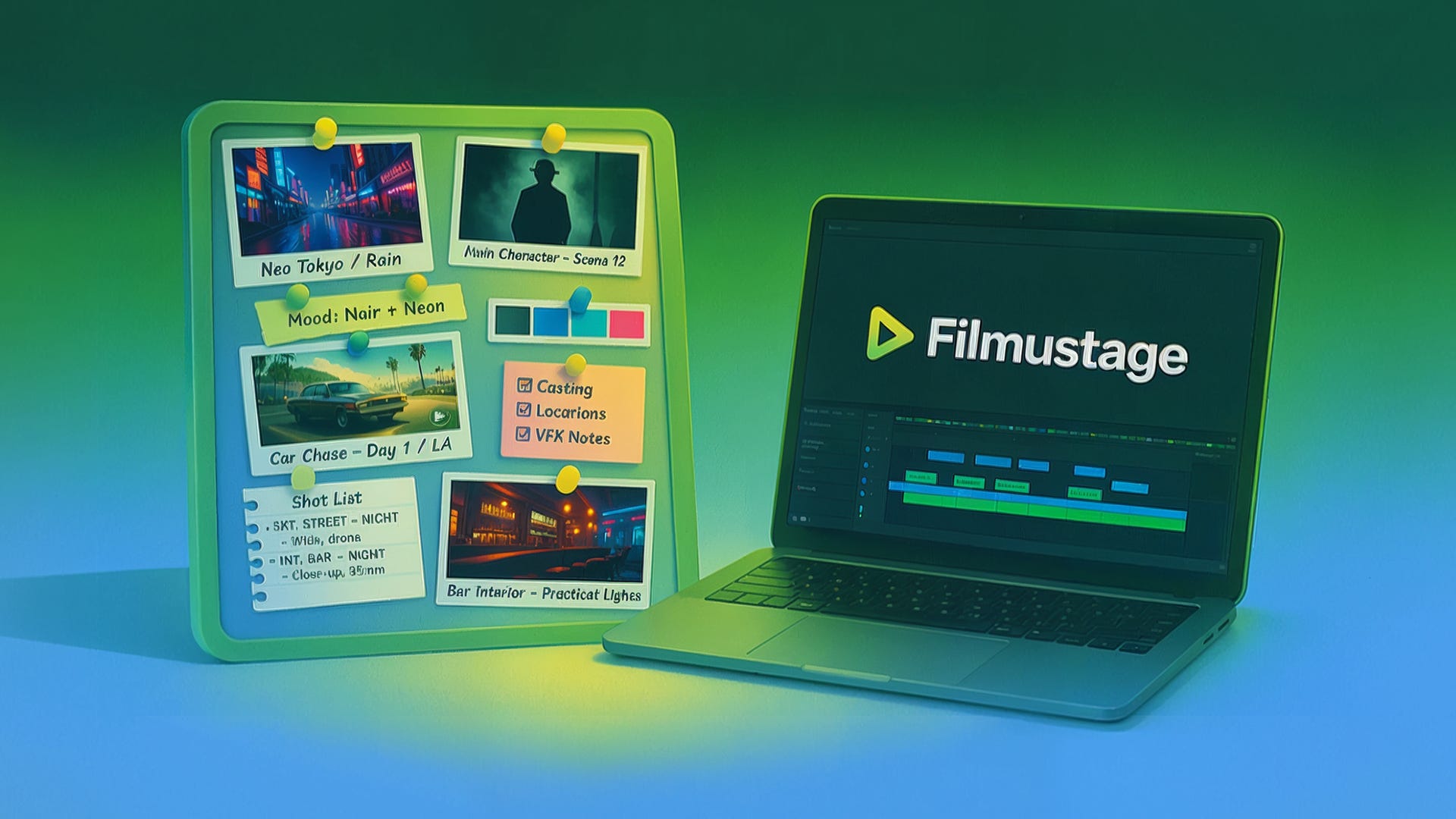
At the briefing stage, language models can, within minutes, produce draft scripts, logline options, and different angles for platforms like YouTube, Reels, LinkedIn, etc., radically shortening the cycle of idea generation and approvals. Studio pre‑visualization is becoming interactive: AI services generate animated storyboards, sample lighting setups, camera movements, and scene rhythm — sometimes already in the future film’s or campaign’s visual style.
A separate layer of change is in planning. Specialized tools like Filmustage automatically break the script into scenes, estimate shooting days, map locations, and calculate budgets, helping producers foresee bottlenecks and risks in advance. Essentially, before the team even sets foot on set, they already have a fairly clear picture of what they will get in each scene.
Doug confirms this thought:
– The ability to express a vision in a refined, visual manner during pre-production is a massive asset for client buy-in. I’ve evolved my process from static vision boards to animated sequences. This isn’t just for show; it’s a functional blueprint for my creative team to understand lighting, optics, and camera angles before we ever set foot on a physical set.
Will AI Destroy Creative Individuality?
At this point we step onto thin ice: how strongly does AI affect creativity, and what is its role in the genuinely creative part of the process? Fully autonomous creative systems are already being discussed: systems in which AI not only executes human requests, but also proposes narrative and visual solutions based on audience engagement data. Another discussing area is almost real‑time localization of content for different markets and cultural contexts.
Doug acknowledges that AI’s influence on creativity is growing, and this brings not only opportunities but also risks:
– AI is no longer a peripheral influence; it is woven into every layer of the creative stack. From the first draft of a creative brief or script to storyboarding, production, and post-production VFX, no stage remains untouched. These tools offer unprecedented efficiency, but I always maintain a healthy skepticism: increased efficiency does not inherently mean superior quality. As the sayin
g goes, it’s not the tool, it’s the person wielding it. A more efficient brush doesn’t make a better painter.
Is there a risk that AI is killing creative individuality? The risk is real. If a model is only trained on a finite “ingested” dataset, we face a feedback loop of visual homogeneity. The responsibility now falls on the filmmaker to intentionally build imperfection back into the machine. We must resist the “baked-in” style of the algorithms to ensure our individual voices aren’t drowned out by the average of the data.
When it comes to creative products, traits and skills that AI still lacks remain extremely important: interpretation, empathy, and a unique point of view - directing, storytelling, working with real people in documentary, complex brand narratives. The question is whether AI will be able to master these things and convincingly simulate human unpredictability.
Doug believes it’s a matter of time, but right now AI faces another, more pressing problem that must be overcome:
– It’s a matter of time, but currently, we are battling a significant “beauty bias” in AI models. When you prompt a period piece (like Vikings at war) the output often gives you characters with chiseled jaws and perfect dental work, which immediately shatters the suspension of disbelief. My current creative struggle is “dirtying” the image injecting imperfection and grit back into the frame to counteract the sterile, plastic perfection that AI defaults to.
I certainly would have utilized contemporary finishing and restoration tools to polish earlier projects that were limited by the technology of their time. However, there is a distinct line where efficiency must yield to empathy. For instance, my work on the Special Olympics for Bank of America is something I would never delegate to an algorithm. That project required a level of raw, unvarnished authenticity that is deeply personal. Some stories require a human witness, not a digital synthesis.
Documentary, Truth and Trust in the Deepfake Era
At this level of technological maturity, truthfulness and accuracy have become central issues. Visual quality has improved so much that you can no longer automatically judge from a single clip whether “this really happened” or not. Generative video and deepfake technologies make it possible to create scenes and speeches that never actually occurred, with photorealistic lighting, faces, and voices.
Research and early industry cases show that even specialized algorithms still struggle to reliably distinguish synthetic video from real footage, while ordinary viewers almost entirely rely on context and trust in the source. In this environment, accuracy, transparency, and ethics in video production remain critically important, especially for documentary work.
As a documentary director, Doug is acutely aware of this responsibility:
– In documentary, where “The Real” is our currency, the stakes of using AI are incredibly high. I am hyper-vigilant about which tools I invite into the process. I occasionally use AI to animate abstract thoughts or historical scenarios that were previously cost-prohibitive, but I do so with transparency. Documentary audiences have a refined “truth-meter”; they demand authenticity. We have to weigh the risk of being perceived as misleading against the benefit of visual illustration. In this genre, AI must serve the truth, not replace it.
Will Everyone Become a Director?
Finally, we come to the question of democratization. If advanced tools are becoming accessible to almost everyone, does that mean there will be radically more directors and films and will quality grow as a result?
It is unlikely that anyone can answer this better than a director:
– If high-end tools are accessible to everyone, does everyone become a director?
The word processor didn’t turn everyone into a novelist, but it did allow the best writers to surface more efficiently. We are seeing a democratization of the film process that will allow “cream of the crop” talent to rise, regardless of their access to expensive legacy equipment.
My advice to the next generation: don’t just focus on the technicalities of a film degree. Seek out a rigorous liberal arts education. Travel, experience diverse cultures, and study the classics. In a world where anyone can generate an image, the primary skill of the director will be perspective - having something meaningful to say with the tools at your disposal, Doug concludes.